Legal Scholars Convene for Book Workshop on “Torts and Retribution”
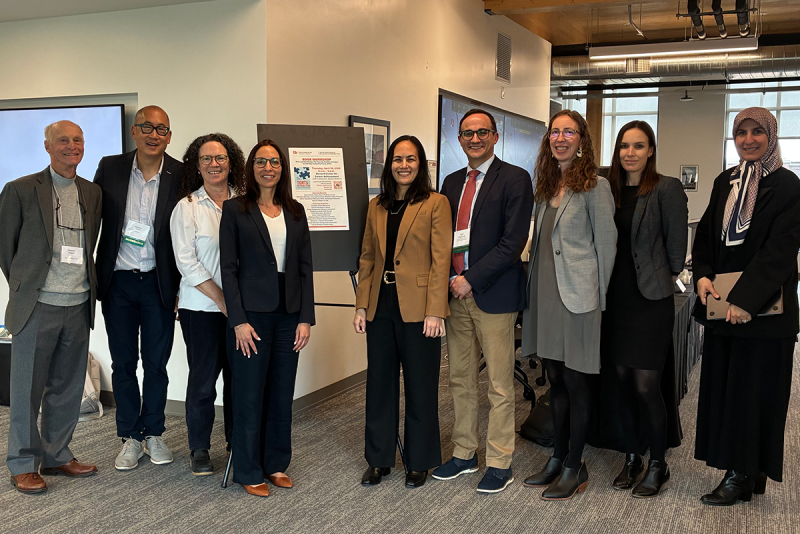
Sturm College of Law faculty members were among the scholars participating in the workshop: (l-r) Emeritus Professor Stephen Pepper; Professor of Law & Maxine Kurtz Research Scholar Bernard Chao; Professor Viva Moffat; Associate Professor María Guadalupe Martínez Alles; Associate Dean for Faculty Scholarship & Provost Professor Nancy Leong; Assistant Professors Seth Packrone, Elizabeth Jordan, and Amanda Savage; and Associate Professor Zahra Takhshid. (Photo: Nancy Leong)
On April 30, the Sturm College of Law and the Ved Nanda Center for International and Comparative Law hosted a book workshop on Torts and Retribution: The Case for Punitive Damages (Cambridge University Press, 2025), an academically significant publication by Associate Professor María Guadalupe Martínez Alles. The day-long event, held at the University of Denver’s Burwell Center for Career Achievement, brought together a group of U.S. and international scholars to debate and discuss the book’s conceptual framework of “relational retribution,” and the expansion of tort theory into the realm of punitive damages.
This convening marked the third workshop featuring scholarship around the ideas in Martínez Alles’s book, following similar events at Universidad Adolfo Ibáñez in Chile last November and at the University of Girona in Spain in February. A scholar from each of those institutions returned to contribute to the panels at DU. Martínez Alles noted that the structure of each event was somewhat different; this one featuring a broader array of scholars and topics related to the book’s themes.
Scholars from Around the World
Bruce Smith, dean of the Sturm College of Law, and Malcolm Wheeler, counsel emeritus of Denver law firm Wheeler Trigg O’Donnell, along with Martínez Alles, gave opening remarks to provide context and an introduction to the day’s discussions.
The workshop featured four panels, each focusing on different themes, from the idea of relational retribution — which focuses not just on the imposition of punishment for wrongdoing but also the relationship of the victim to the wrongdoer — to the way retribution is applied in a mass market setting, comparative legal perspectives, and the role of privacy and market regulation in the digital age.
The day’s first panel, “On Relational Retribution,” featured contributions from Professors Douglas Husak (Rutgers University), Erik Encarnacion (University of Texas Law School), and Diego Papayannis (University of Girona). The second panel, “Retribution in the Mass Market Setting,” included discussions of corporate malfeasance, punitive damages, and products liability with Professors Gregory Keating (USC Gould School of Law), Anita Bernstein (Brooklyn Law School), and Zahra Takhshid (University of Denver Sturm College of Law).
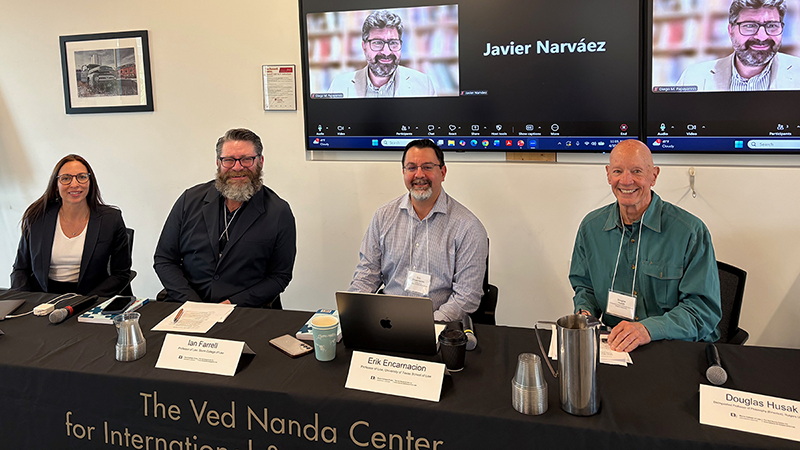
Following a lunch break, the afternoon panels began with “Comparative Perspectives,” featuring international law scholars, Professors Matthew Dyson (Oxford University), Alberto Pino Emhart (Universidad Adolfo Ibáñez), and Benjamin Liebman (Columbia Law School). The final panel, “Joint Conversations: Privacy and Market Regulation,” included Professors Adrian Kuenzler (Hong Kong University) and Lauren Scholz (Florida State University).
Each of the panel’s moderators were Denver Law faculty members with specialized expertise in the topics of the panels: Professor Ian Farrell, Assistant Professor Seth Packrone, Professor Kelley Loper, who also directs the Ved Nanda Center, and Professor and Maxine Kurtz Research Scholar Bernard Chao.
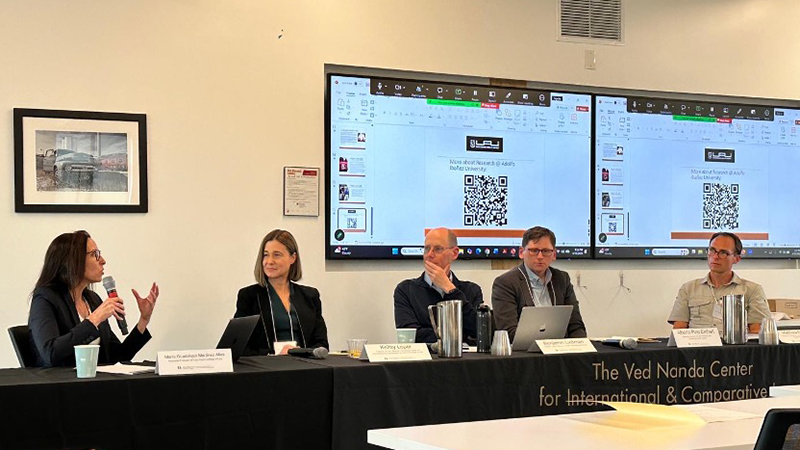
Following each panel’s presentations, Martínez Alles had an opportunity to comment on the panelists’ observations, insights, and arguments, followed by audience interaction and questions.
Associate Dean for Faculty Scholarship and Provost Professor Nancy Leong commented, “this engaging and inspiring conference brought together a distinguished international community of scholars to discuss Torts and Retribution, reflecting the book’s significant contribution to debates on punitive damages and the theory of private law.”
The full program for the day is available here.