Judge Heidi Kutcher: A Model of Mentorship

There’s something about Judge Heidi Kutcher, BA’96, JD’99, that makes you smile. It’s not simply her equanimity or her obvious passion for the law. It’s a deep-rooted care for others.
It’s that she learns her externs’ favorite candy and stocks her chambers accordingly. It’s that she encourages them to get enough sleep. It’s that she creates space for them to engage in critical thinking, receive feedback, and pursue growth.
It’s the sense that, when you are with her, it is you she cares for the most.
“Judge Kutcher shows that mentorship is selfless, mentorship is involved, and mentorship is broad,” says rising 3L T’Phani Perley-Schiele, one of Kutcher’s recent externs. “She is a fantastic model for what mentorship can and should be.”
An Ethic of Care
Whether it’s her nearly two decades at the U.S. Department of Education’s Office for Civil Rights (OCR), mentoring law students, or serving in her current role as district court judge for the 2nd Judicial District, Kutcher’s ethic of care shines through.
“You might think it’s being a judge,” she says when asked about her greatest professional accomplishment, “but it’s really not. It’s the fact that for 18 years [at OCR] I got to help kids, not charge anyone money, and make sure they could get an education so they could achieve their goals.”
Although her commitment to serving others has always been strong—passage of the Americans with Disabilities Act is what reinforced her decision to pursue law school—Kutcher is also a reflection of her own mentor’s care for others.
“I joined the Rhone-Brackett Inn of Court as a 3L,” she recalls, “which is where I met Judge Harrell, who became my mentor.”
Nearly three decades later, Judge Alfred Harrell, JD’71, remains a steadfast presence in Kutcher’s life. It was Harrell who encouraged Kutcher to consider serving in the judiciary. It was also Harrell who connected Kutcher with extern Perley-Schiele.
“I can’t remember how exactly,” says Perley-Schiele, “but it began with a lunch 1L year with Justice [Carlos] Samour [JD’90] and Judge Harrell.” The following year, Harrell asked Perley-Schiele to help plan that same lunch, and Kutcher attended. “Judge Kutcher mentioned she was looking for externs, and Judge Harrell connected us.”
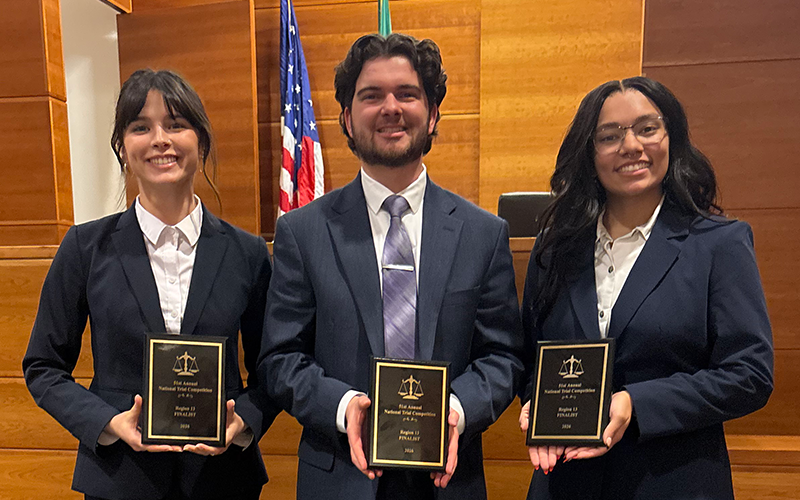
For Perley-Schiele, this type of multi-generational investment in students is critical. “The profession is slow to change and there is a generational gap,” she observes. “We’re starting to see the push and pull of what each generation values. Mentorship bridges that disconnect—in order to have a legal profession that survives and continues to serve the community, you have to bring up the next generation of attorneys.”
In other words, says Perley-Schiele, “the only way students are going to know how to be strong attorneys is by learning from strong attorneys.”
Kutcher would agree. “I’ve had so many great mentors throughout my career,” she reflects. “So many people have been so generous with their time that it’s important for me to give back.”
A Commitment to Students
Kutcher sees the next generation of attorneys as an obvious place to give back. But obvious does not mean ordinary, and Kutcher’s devotion to law students and legal education is anything but.
Not only does Kutcher serve on the law school’s Alumni Council, she has been a mentor in the Michael G. Massey Professional Mentoring Program for more than 15 years and serves as a supervisor in the Sturm College of Law’s robust externship program.
“It keeps me young,” she says. “It keeps me looking at the next thing that’s going to be happening in the law. It helps keep me excited about the law in general.”
Kutcher, of course, also teaches her students quite a lot.
“After every single hearing, we did a debrief,” says Perley-Schiele. “She would talk to me and the other extern about our questions, she would ask what we learned—did we agree or disagree with each attorney’s position? She would then explain key concepts and ask again.”
Kutcher explains to all of her externs: “The most important thing you’re going to do is be here in the courthouse. I want you here watching, learning, and asking questions.” This, to Kutcher, is what experiential learning is all about.
“When you’re in law school, you’re reading about all these cases, about why they got there and what sort of facts led to where a jurist made this decision…it’s a bit divorced from what you as a lawyer will actually be doing. Seeing lawyers in action, whether it’s in a law firm setting or in a courtroom, gives you that understanding of what being a lawyer actually looks like.”
Kutcher believes that experiential learning is particularly valuable for students who did not have exposure to the legal community prior to attending law school. The child of a teacher and an aerospace engineer, Kutcher understands what it’s like to step into the legal world for the first time. Her goal? To create a safe space.
“There was never a time where I didn’t feel like I could walk into her chambers and ask a silly question,” recalls Perley-Schiele. “She’s very open, and I respect that.”
Kutcher’s openness—not just to questions but to discussing all aspects of student and lawyering life—underscores the importance of care: “Most of my externs come to me and say, ‘It’s not as scary as I thought. I can do this.’ And for those who don’t have personal experience before going to law school, it’s invaluable.”
A Dedication to the Public Good
Kutcher’s ethic of care is also tied to serving the public good.
“Judge Kutcher has a big focus on the community,” says Perley-Schiele. “Your practice isn’t just what you’re practicing, it’s how you’re contributing back to your community.”
But for Kutcher, serving the public good—working in the public’s interest—is a broad term.
“Public interest work,” she explains, “is not just a government job, not just a nonprofit. You can still do public interest work and not be in one of those roles.”
It’s important to understand this, she says, because more traditional public interest roles may not be feasible for everyone: “There is no shame in having to pay the bills and keep the lights on and follow a passion that isn’t fully public interest.”
Engaging in pro bono work, serving a community organization, volunteering to support pro se litigants—these are all ways that Kutcher believes lawyers can serve the public interest. It’s a philosophy that Perley-Schiele absorbed during her externship: “There is no one path to serving the community.”
As Perley-Schiele notes: “Judge Kutcher mentors in many different ways—through externships, through affinity groups, by being an involved alum. She will make active moves to help you and your career. She is an excellent blueprint for what a mentor should be.”
Kutcher is also an excellent blueprint for what it looks like to serve the public good. Not simply because she’s driven by a care for others, but because, when asked how this work has added value to her life, her response is simple: “I love giving back.”
Kutcher encourages attorneys interested in serving the public good to explore the Denver District Court’s Ask-a-Lawyer Program. She is also creating a mediation program for pro se litigants where volunteers can be trained to mediate in the 2nd Judicial District.