Environmental Law Clinic Secures Collaborative Settlement on Behalf of Client

Environmental Law Clinic students represented Save the World's Rivers in a settlement to prevent future construction of a large on-channel dam and reservoir on the South St. Vrain Creek (above).
After more than three years of work by successive teams of students, the Sturm College of Law's Environmental Law Clinic (ELC) has helped secure a settlement between its client Save the World’s Rivers (STWR) and the St. Vrain and Left Hand Water Conservancy District (District) to prevent the construction of an on-channel dam along the South St. Vrain Creek.
The District’s water rights came about in 1971, when the entity was created in part to build a proposed reservoir known as the Coffintop Reservoir, through a partnership with the U.S. Bureau of Reclamation. The District itself is a nonprofit entity with a government-appointed board that holds water rights for the benefit of the community. Through the settlement, the District has agreed to use its water rights for community needs in ways that avoid the construction of a large dam and reservoir.
A Model of Collaborative Problem-Solving
The case began as a routine legal filing in 2024, when the District filed a six-year diligence application in water court to maintain the water storage rights associated with Coffintop Reservoir project. The filing prompted STWR to submit a statement of opposition, starting what could have been an adversarial court process.
Instead, through representation by Environmental Law Clinic students, STWR found common ground with the District.
Sturm College of Law Associate Professor Wyatt Sassman, who directs the ELC, commented that “One important part of this recent settlement is how collaborative it was. Through their representation in the water court process, the clinic's students were able to create a space for our client and the water user to identify shared interests and build trust.”
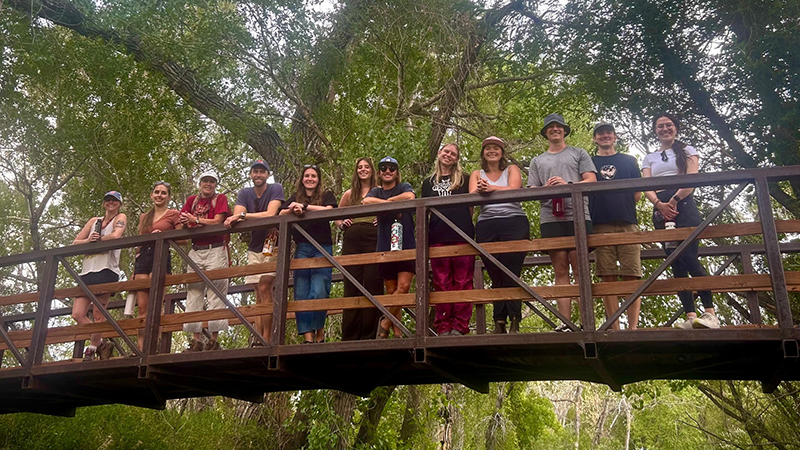
A joint press release from STWR and the District further described the success of the process. Sean Cronin, executive director of the District, said that he “gained respect for [STWR’s] objectives, and…willingness to come to the table and talk through complicated issues." Gary Wockner, executive director of STWR, described the collaboration saying “it became clear through discussions that the District shared values around avoiding a new on-channel dam while still meeting its mission.”
Under the agreement, the District will forgo using the Coffintop water rights for any new on-channel reservoir. Instead, it will return to water court with plans to use the water rights at alternative locations in ways that align with community needs, environmental goals, and water management objectives — approaches the District has been exploring for more than a decade with the City of Longmont, Town of Lyons, Boulder County Parks and Open Space, local environmental organizations, and food producers.
"The challenges around water have only grown more complex over the last 50 years," said Chris Huffer, Longmont Director of Water and Waste Service. "The District has a solid water plan, and the City is an eager partner in realizing the greatest potential of these water rights."
Better Outcomes Through Community Participation
The Environmental Law Clinic continues to represent clients in water court and has expanded its work to include helping ranchers in the San Luis Valley explore options that protect both their historic irrigating practices and the riparian habitats where they live and work.
Sassman described the importance of the outcome to the ELC: “by creating this opportunity for shared success, this settlement reflects a core commitment of the Environmental Law Clinic's work — that, when given a meaningful opportunity to contribute, affected communities' participation in decision making leads to better outcomes for everyone.”